Navigating Volatility: The Engineering Imperative in a High-Risk Middle East
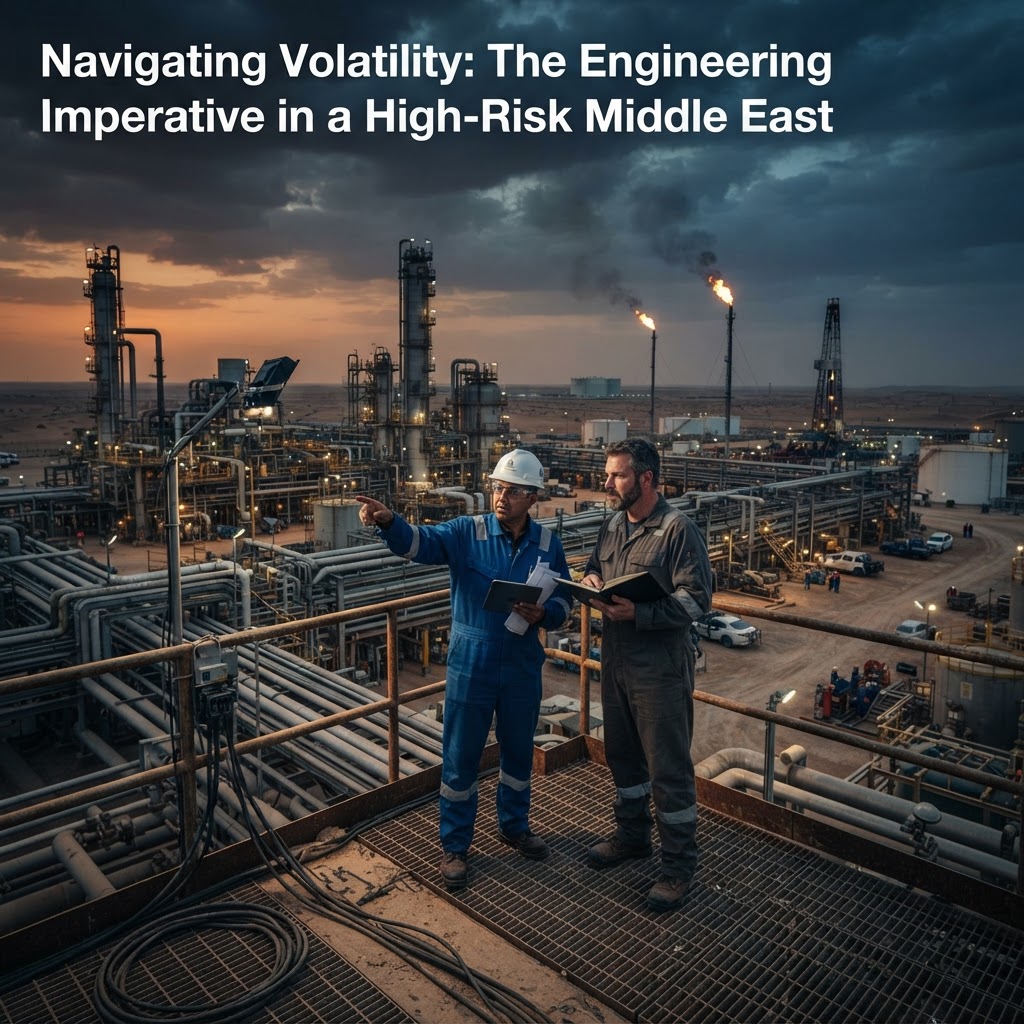
As Brent crude prices breach $100 amid regional instability, Atticus Energy examines how engineering firms must pivot to prioritize asset resilience and supply chain security.
The recent escalation of hostilities in the Middle East has sent shockwaves through global energy markets, with Brent crude prices climbing past the $100 mark as of mid-September 2026. For engineering consultancies and project developers, this is not merely a market fluctuation; it is a fundamental shift in the risk profile of capital projects. As we observe the impact of strikes on critical infrastructure, such as the recent damage to the Saudi East-West pipeline, the industry must confront the reality that 'business as usual' is no longer a viable strategy.
Prioritizing Asset Resilience
In an environment where physical assets are increasingly vulnerable, the focus of project delivery must shift from pure cost-optimization to extreme resilience. Engineering teams are now tasked with designing infrastructure that can withstand not only operational stress but also targeted disruptions. This requires a deeper integration of security-by-design principles, where redundancy in pipeline networks and decentralized processing capabilities become standard requirements rather than optional enhancements.
Supply Chain and Operational Continuity
The current geopolitical climate has exposed the fragility of global supply chains. With shipping lanes in the Strait of Hormuz under constant threat, the logistical challenges of moving equipment and materials to project sites have intensified. For our clients, this necessitates a move toward localized procurement strategies and the stockpiling of critical long-lead items. At Atticus Energy, we advise our partners to conduct rigorous stress tests on their supply chains, identifying single points of failure that could derail multi-billion dollar capital investments.
Furthermore, the volatility in borrowing costs, driven by these regional fears, means that project financing is becoming increasingly expensive. Engineering firms must demonstrate superior project management capabilities to maintain investor confidence. By leveraging digital twins and predictive maintenance, operators can extend the life of existing assets and optimize output, providing a buffer against the financial pressures of the current market. The path forward requires a blend of traditional engineering excellence and a sophisticated, strategic approach to risk management that accounts for the realities of a fractured geopolitical landscape.