From Extraction to Injection: The Maturation of North Sea CCS Hubs
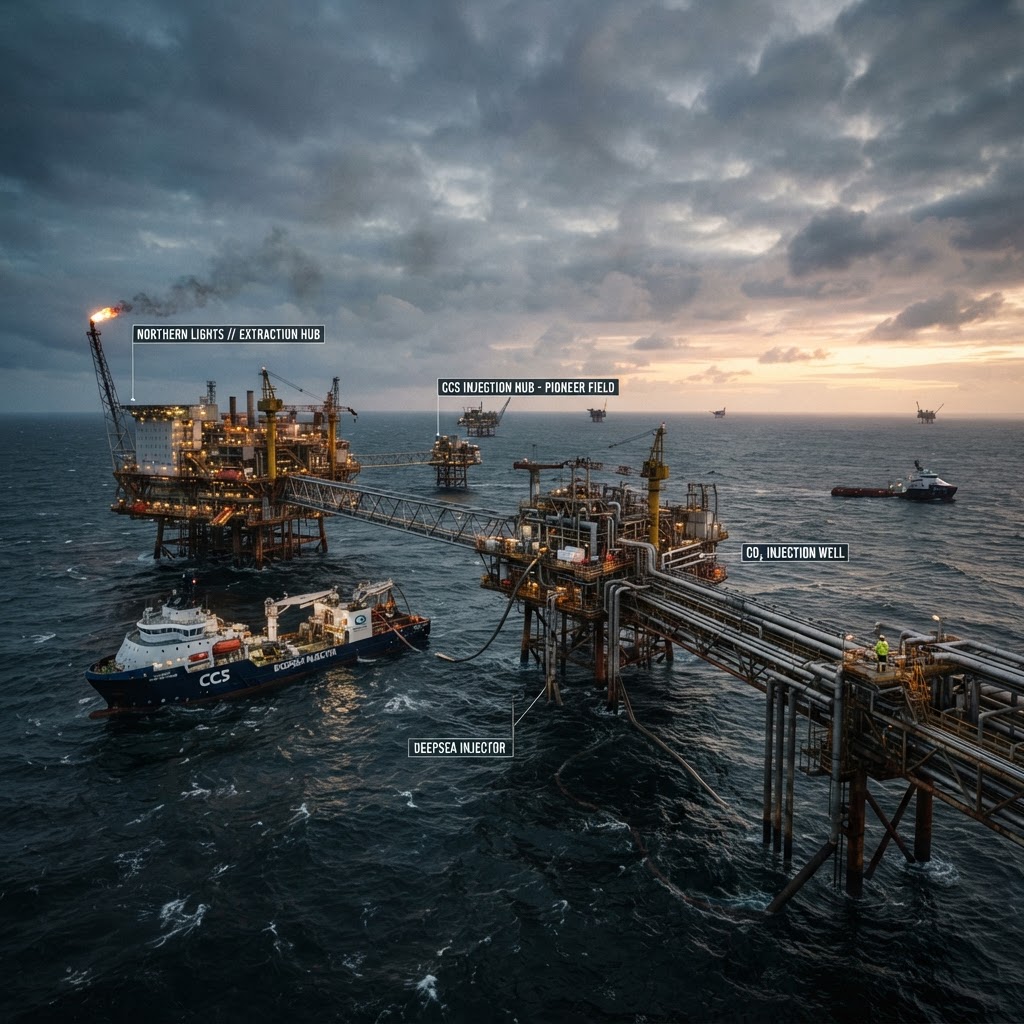
As Northern Lights celebrates a year of operation and the Northern Endurance Partnership secures new leases, the North Sea is proving that carbon storage is no longer an experiment, but a vital industrial infrastructure asset.
The North Sea is currently undergoing a profound metamorphosis. Once the frontier of offshore oil extraction, it is now the epicenter of the global Carbon Capture and Storage (CCS) industry. With the Northern Lights project having successfully completed its first year of commercial CO2 storage and the Northern Endurance Partnership (NEP) recently securing critical storage leases, the 'Carbon-as-a-Service' model has officially matured. For Atticus Energy’s European clients, this signals a shift from pilot-phase uncertainty to large-scale infrastructure deployment.
Engineering the Reversal
The technical challenges of CCS are often underestimated by those outside the engineering core. Transitioning from producing hydrocarbons to injecting liquid CO2 requires a fundamental reversal of flow dynamics and metallurgical considerations. The NEP’s recent progress highlights the engineering rigor needed to manage dense-phase CO2 transport across hundreds of kilometers of subsea pipelines. At Atticus, we emphasize that the true value lies in infrastructure resilience. Repurposing legacy oil and gas assets—platforms, wells, and pipelines—for carbon storage is an exercise in lean engineering that can save billions in capital expenditure, provided the integrity assessments are impeccable.
The Regulatory and Economic Catalyst
What makes the current developments in the UK and Norway so significant is the alignment of engineering capability with regulatory clarity. The establishment of cross-border CO2 transport protocols in Europe has created a viable market for industrial emitters in landlocked regions to export their emissions. This is a critical development for strategic advisors. We are now seeing the emergence of a 'CO2 value chain' that mirrors the early days of the LNG industry. The project delivery models used in the North Sea—often involving joint ventures between traditional rivals like Equinor, Shell, and TotalEnergies—provide a template for how high-capex transition projects can be executed successfully.
However, risks remain. The scaling of these hubs requires a sophisticated approach to risk management, particularly regarding long-term liability and reservoir performance. As engineering consultants, our role is to ensure that the excitement of the transition does not bypass the necessity of technical due diligence. The North Sea is proving that the oil and gas industry possesses the unique skillset required to solve the climate challenge, turning a sunset province into a sunrise industry for the net-zero era.
Source: https://www.factset.com/insight/carbon-sequestration-projects-north-sea