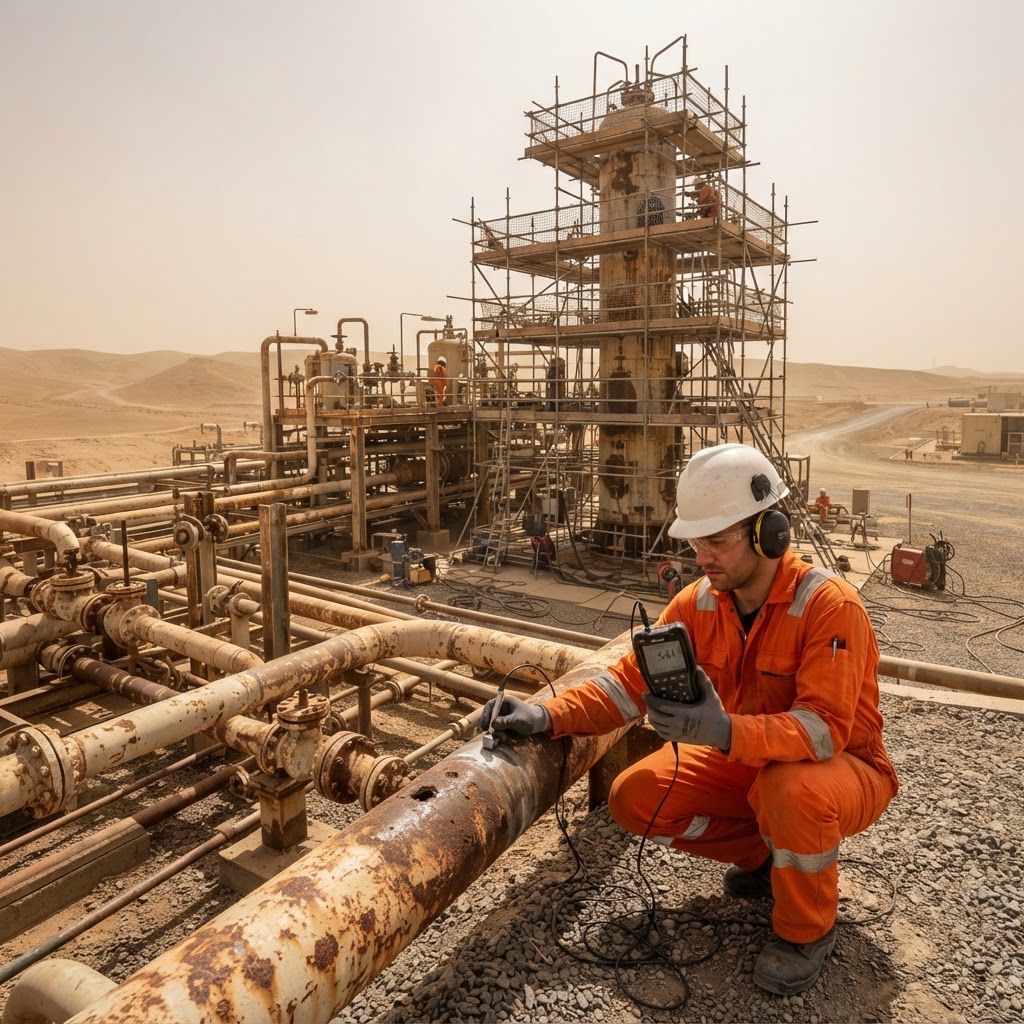
Brownfield rehabilitation: rehabilitate, re-rate or replace?
Bringing idle or ageing plant back into service can be far cheaper than building new, but only if the scope is based on evidence. A structured, item-by-item screen turns condition data into clear decisions.
The situation
Ageing plants face a repeated question: repair and extend existing equipment, or replace it. A sound decision combines integrity condition, remaining life, obsolescence, safety-critical performance and whole-life cost. It should not rest on first cost or engineering preference alone.
Why brownfield is different
A greenfield project starts from a blank sheet. A brownfield project starts from what is already there: equipment of unknown condition, drawings that may not match the plant, and operating history that lives in people's memories. The prize is real, because reusing tanks, vessels, pipe racks and foundations can save a great deal of cost and time. So is the risk.
A simple screen for every item
The diagram shows the screen we use on each equipment item or system:
- Do records exist? Data sheets, as-built drawings, inspection and repair history. If not, survey and inspect to rebuild them before deciding anything.
- Is the condition acceptable? External visual inspection, wall-thickness surveys, coupons, and internal inspection where access allows.
- Is it still fit for the new duty? Design pressure and temperature, capacity, materials (especially for low-temperature service) and current code requirements.
The outcome for each item is one of four: rehabilitate and reuse, re-rate or modify, repair or replace, or decommission.
Decision sheets
For each item or system, a one- or two-page decision sheet records:
- what was inspected and how,
- the findings,
- the options considered, with rough cost and schedule,
- the recommendation and who agreed it.
Decision sheets turn a large condition survey into a scope definition that procurement and construction can use. They also make it easy to revisit a decision if new findings appear.
Watch-points
- Low-temperature service. Materials that were fine for ambient duty may not be suitable if a tank or line is being converted to refrigerated service.
- Instrumentation and control. Old systems may be obsolete even where the mechanical equipment is sound.
- Electrical. Hazardous-area certification and protection settings need checking against current standards.
- Civil and structural. Settlement, corrosion of supports and fireproofing condition are easy to overlook.
- Long-lead items. Identify them early. A late discovery that a large vessel or compressor must be replaced will set the critical path.
Key Takeaways
- Start with records. Missing data sheets and inspection history are a scope item, not an excuse.
- Screen every item the same way: records, condition, fitness for the new duty.
- Write a decision sheet per item or system so the reasoning survives handover.
- Long-lead items found late are the biggest schedule risk in brownfield work.
How Atticus helps
We plan and run condition assessments, prepare decision sheets and scope definition reports, and identify long-lead items early so execution can be planned with confidence.
Real-world examples
Chevron Richmond refinery fire — CSB (2012)
A low-silicon carbon steel pipe in a crude unit thinned by sulfidation corrosion and ruptured, causing a large fire. Thousands of local residents sought medical attention. The CSB highlighted missed opportunities to replace susceptible piping identified years earlier: a classic rehab-or-replace decision that was deferred.
Read the investigation / sourcePrudhoe Bay pipeline leak (2006)
Internal corrosion in an oil transit line went undetected because the line had not been cleaned and pigged for years. The result was a significant spill and a partial field shutdown. It shows the cost of extending life without adequate inspection data.
Read the investigation / sourceIf you get it wrong
- Loss of containment from equipment kept in service beyond its real remaining life.
- Repeated unplanned shutdowns and deferment.
- Over-spending on like-for-like replacement where targeted repair was enough.
- Obsolete controls and spares that make later upgrades harder and costlier.
Relevant standards
Links go to the publisher's official page (ISO, IEC, BSI, API, NFPA, HSE and others). Most standards must be bought from the publisher.
- ISO 55000:2024 — Asset management: vocabulary, overview and principlesiso.org
- API standards catalogue (API 520/521, 580/581, 618, 625, 650, 754 and more)api.org
- ISO 14224:2016 (BS EN ISO 14224) — Reliability and maintenance dataiso.org
- ISO 15663:2021 (EN ISO 15663) — Life cycle costingiso.org
- HSE L122 — Safety of pressure systems (PSSR ACoP)hse.gov.uk
Further reading
- Asset managementen.wikipedia.org
- Risk-based inspectionen.wikipedia.org
- Total cost of ownershipen.wikipedia.org
Take this briefing with you
A one-to-two page PDF summary: situation, diagram, key takeaways, consequences, examples and standards.