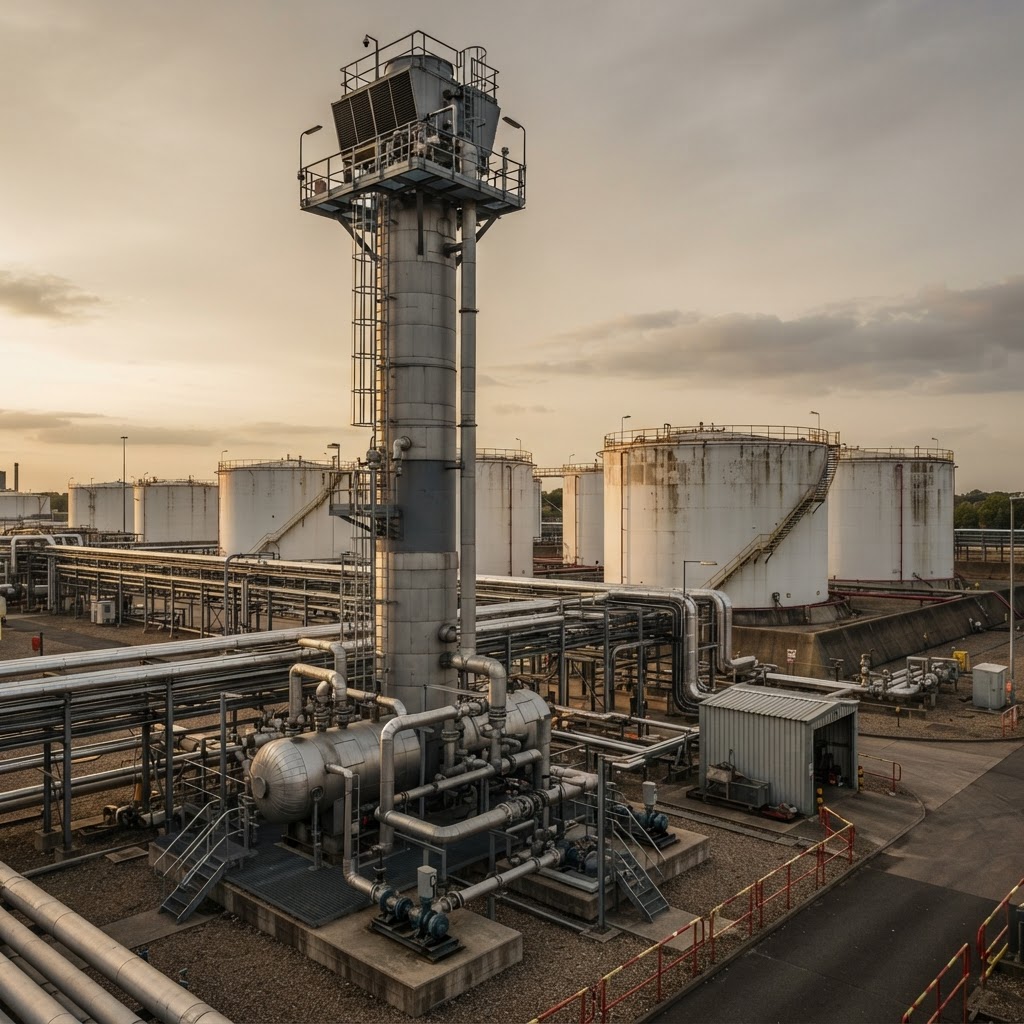
Condensate stabilisation: making liquids safe to store and ship
Raw condensate carries light ends that flash in tanks and ships. Stabilisation strips them out so the product meets its vapour pressure limit and storage stays safe.
The situation
Raw condensate holds dissolved light ends. Stabilisation (flash stages or a stabiliser column) lowers the vapour pressure (RVP/TVP) so the product can be stored in atmospheric tanks and shipped safely.
Why stabilise
Condensate from separators contains dissolved light hydrocarbons. At atmospheric pressure these flash, raising tank pressure, causing vapour losses and creating a fire hazard. Buyers also set a vapour pressure limit for safe shipping.

How it works
The simplest approach is staged flashing at falling pressures. Where a tighter specification is needed, a stabiliser column with a reboiler strips light ends from the liquid. Overhead vapour is recompressed and sent to the gas system.
Design questions
- What vapour pressure must the product meet, at what temperature?
- How much condensate, and how will rate and composition change?
- Where do the overheads go, and is recompression available?
- Does salt or water carried with the condensate need removing?
Operating watch-points
Reboiler temperature and column pressure control product vapour pressure. Fouling from salts, waxes or corrosion products can reduce performance over time, so trend product quality against reboiler duty.
Storage and export
Stable condensate can be stored in floating or fixed-roof tanks with appropriate vapour control. Blending with crude is another outlet where specifications allow.
Key Takeaways
- Stabilisation controls vapour pressure and storage safety.
- Choose flashing or a column by how tight the specification is.
- Plan where overhead gas goes.
- Trend product quality against reboiler duty to spot fouling.
How Atticus helps
We size stabilisation systems, troubleshoot off-spec condensate, and plan storage and export arrangements for condensate and NGL products.
Real-world examples
Buncefield oil storage depot — HSE (2005)
Buncefield involved the overfilling of an atmospheric tank with volatile petroleum. A large vapour cloud formed and exploded. Volatile product in atmospheric storage, whether through over-filling or high vapour pressure, can create flammable clouds.
Read the investigation / sourceunstabilised condensate to storage
A stabiliser reboiler fault sent high-vapour-pressure condensate to floating-roof tanks. Roof seals vented heavily, gas detectors alarmed and loading was suspended until the product was re-run.
If you get it wrong
- Flammable vapour releases from storage tanks.
- Vapour-pressure non-compliance on export cargoes.
- Lost light-end value to flare.
- Tank roof damage and fire risk.
Relevant standards
Links go to the publisher's official page (ISO, IEC, BSI, API, NFPA, HSE and others). Most standards must be bought from the publisher.
- HSE HSG176 — The storage of flammable liquids in tankshse.gov.uk
- API standards catalogue (API 520/521, 580/581, 618, 625, 650, 754 and more)api.org
- ISO 23251:2019 (BS EN ISO 23251) — Pressure-relieving and depressuring systemsiso.org
Further reading
Take this briefing with you
A one-to-two page PDF summary: situation, diagram, key takeaways, consequences, examples and standards.