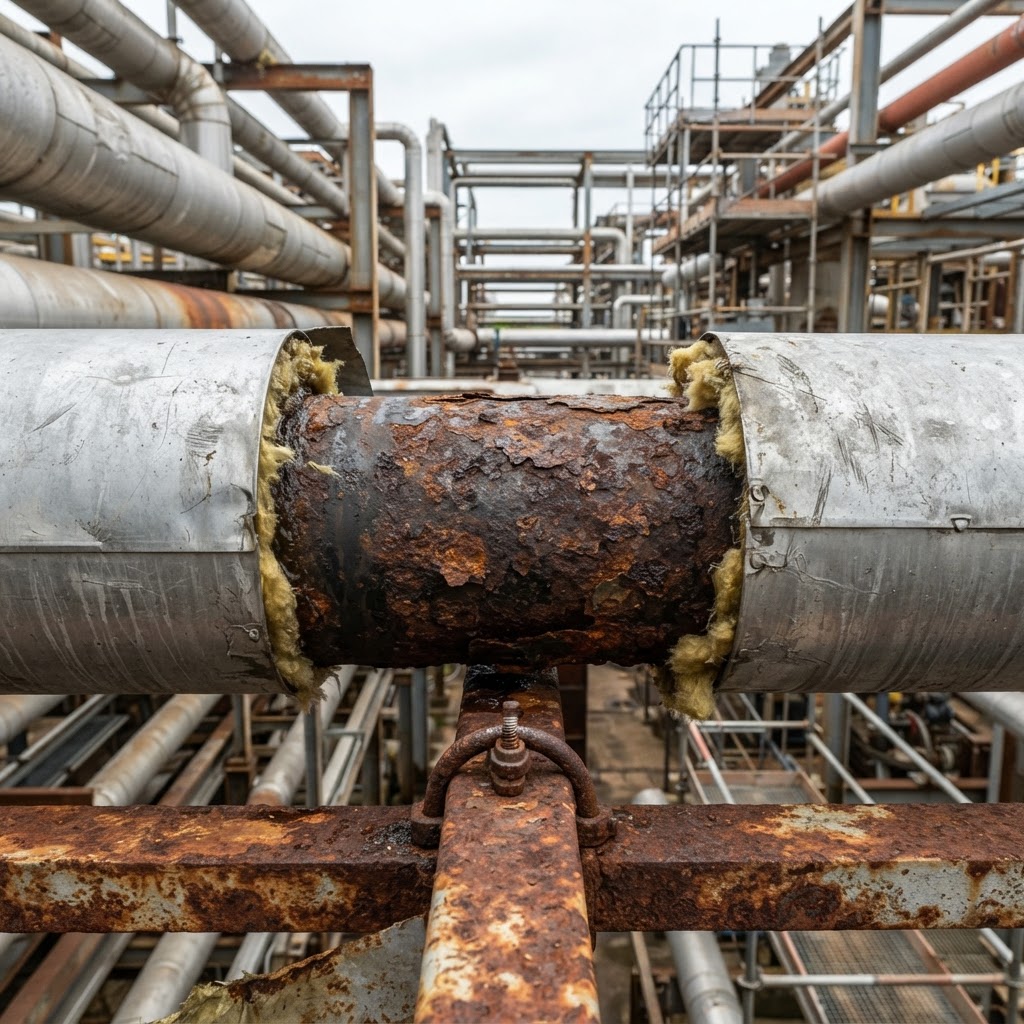
Corrosion under insulation: the problem you cannot see
Water trapped under insulation corrodes pipe and vessels out of sight. Prevention depends on design detail, good installation and a targeted inspection plan.
The situation
Corrosion under insulation (CUI) occurs when water gets beneath insulation or fireproofing and corrodes the steel unseen. Carbon steel operating in the range where moisture can persist (from around freezing up to about 175 °C), and equipment that cycles in temperature, are most susceptible.
Why it happens
Insulation keeps heat in or out, but if water gets behind the jacketing it stays in contact with the steel for long periods. Temperatures in certain ranges accelerate corrosion. Damage is hidden until insulation is removed or a leak occurs.

High-risk locations
- Penetrations, supports and nozzles where jacketing is cut.
- Low points and the bottom of vertical runs.
- Equipment that cycles between hot and cold.
- Damaged or poorly sealed jacketing.
- Areas exposed to deluge testing or steam.
Prevention
- Remove insulation that is not needed, using guards for personnel protection instead.
- Use coatings suitable for the operating temperature under all insulation.
- Choose insulation materials with low water uptake.
- Seal jacketing properly and maintain it.
Inspection
Prioritise susceptible zones. Screening techniques help find wet insulation or wall loss without full removal, but targeted strip-and-inspect remains the most reliable check.
Cold service
Cold insulated systems, such as refrigerated lines, face condensation and ice. Vapour barriers are critical and must be continuous.
Key Takeaways
- Remove insulation that is not essential.
- Coat steel under all insulation.
- Focus inspection on penetrations, supports and low points.
- In cold service, the vapour barrier is critical.
How Atticus helps
We help operators rank CUI risk, plan inspection campaigns and set design standards for insulation on new and rehabilitated plant.
Real-world examples
CUI on a cold service line
A line operating just below ambient was insulated with damaged cladding. Condensation corroded the pipe beneath the insulation until it leaked. Nothing was visible from outside until the release occurred.
Industry context
Industry bodies widely report CUI as a leading cause of unplanned loss of containment in ageing plants. Detection is hard without removing insulation or using screening tools such as radiography or pulsed eddy current.
If you get it wrong
- Sudden leaks from equipment that looks fine.
- High inspection and insulation-removal costs.
- Fire and toxic releases.
- Unplanned shutdowns.
Relevant standards
Links go to the publisher's official page (ISO, IEC, BSI, API, NFPA, HSE and others). Most standards must be bought from the publisher.
- API standards catalogue (API 520/521, 580/581, 618, 625, 650, 754 and more)api.org
- AMPP (formerly NACE) standardsampp.org
- ISO 55000:2024 — Asset management: vocabulary, overview and principlesiso.org
Further reading
Take this briefing with you
A one-to-two page PDF summary: situation, diagram, key takeaways, consequences, examples and standards.