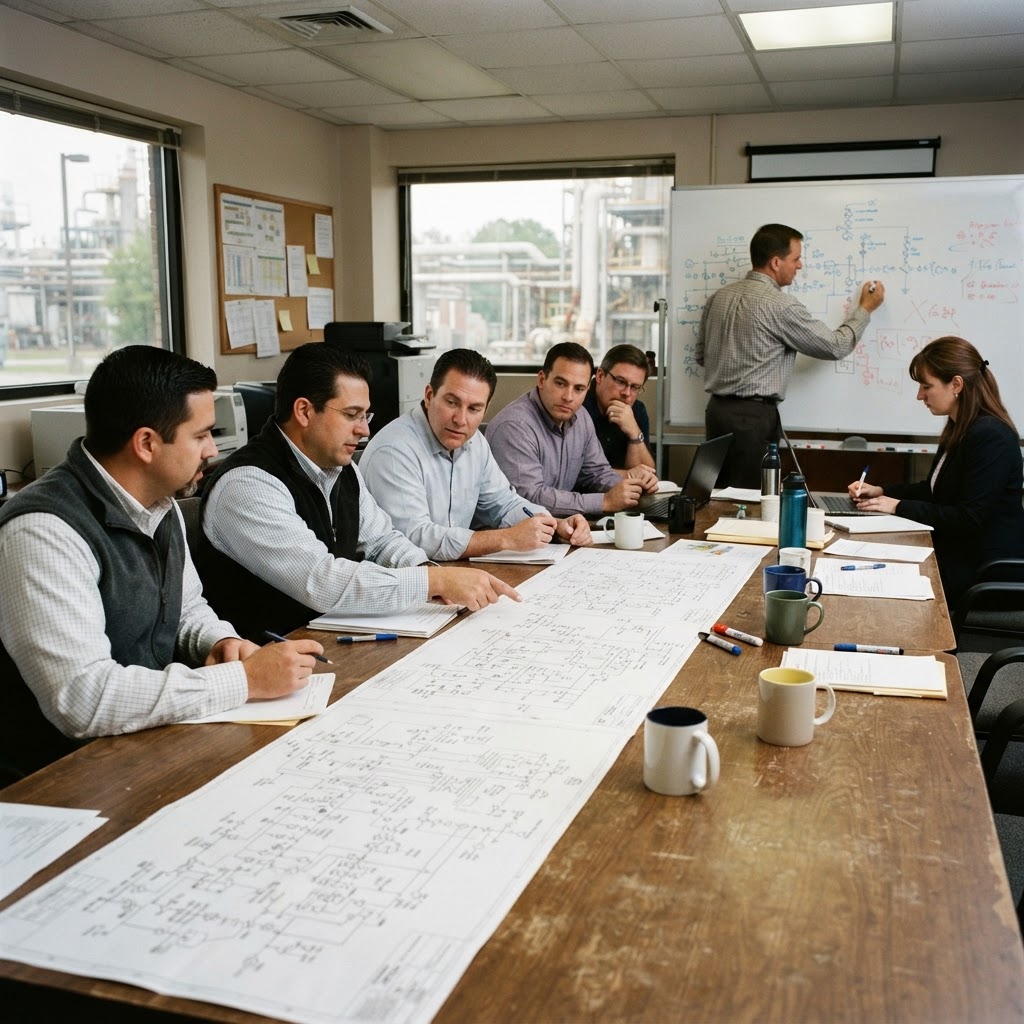
HAZOP facilitation: practical tips from the chair
A HAZOP tests a design line by line against deviations from intent. Good preparation, firm node boundaries and a disciplined record make it effective rather than exhausting.
The situation
HAZOP systematically applies guidewords (no, more, less, reverse and so on) to process parameters at each node, to find deviations, causes, consequences and safeguards. Facilitation quality makes or breaks the study: preparation, pace, team challenge and well-written recommendations.
What HAZOP does
A Hazard and Operability study examines each section of a design against deviations such as more pressure, less flow, reverse flow or higher temperature. It finds safety and operability problems before construction.

Preparation
- Frozen, legible P&IDs and a clear design intent for each node.
- Cause and effect charts, relief data and operating philosophy available in the room.
- Node boundaries marked in advance.
- A team with process, operations, instrumentation and specialist knowledge.
In the room
- State the design intent for the node.
- Apply each relevant parameter and guideword.
- Identify credible causes inside the node.
- Describe consequences without safeguards.
- List safeguards, and only credit independent ones.
- Rank risk and record actions.
Common traps
- Crediting the same instrument as both cause and safeguard.
- Recording consequences after safeguards, which hides severity.
- Long design debates in the room. Note an action and move on.
- Fatigue. Limit session length and take breaks.
Special cases
High-pressure, high-temperature and sour systems, start-up and shutdown modes, and simultaneous operations deserve explicit attention, because standard nodes often miss them.
After the study
Actions should feed into design changes, LOPA where needed, and operating procedures.
Key Takeaways
- State design intent clearly for every node.
- Describe consequences before safeguards.
- Only credit independent safeguards.
- Cover start-up, shutdown and simultaneous operations explicitly.
How Atticus helps
Our engineers chair HAZOP studies, including HPHT and sour gas systems, and support follow-on LOPA and action close-out.
Real-world examples
Flixborough — HSE case study (1974)
At Flixborough a temporary bypass pipe between reactors was installed without proper design review and later failed, releasing cyclohexane that exploded and killed 28 people. The disaster is widely credited with accelerating structured hazard studies such as HAZOP and management of change.
Read the investigation / sourceWilliams Geismar olefins plant — CSB (2013)
At Williams Geismar, the CSB found that process hazard analysis and management of change did not identify that a heat exchanger could be isolated from its relief device. That is a deviation a well-run HAZOP should catch.
Read the investigation / sourceIf you get it wrong
- Credible deviations missed, leaving unprotected scenarios.
- Over-reliance on administrative safeguards.
- HAZOP fatigue producing a tick-box study.
- Recommendations that are unclear or never closed.
Relevant standards
Links go to the publisher's official page (ISO, IEC, BSI, API, NFPA, HSE and others). Most standards must be bought from the publisher.
- IEC 61882:2016 — Hazard and operability studies (HAZOP) application guidewebstore.iec.ch
- IEC 31010:2019 — Risk assessment techniqueswebstore.iec.ch
- ISO 17776:2016 — Major accident hazard management during designiso.org
- OSHA — Process Safety Management (29 CFR 1910.119)osha.gov
Further reading
- Hazard and operability study (HAZOP)en.wikipedia.org
- US Chemical Safety Board — investigation reports and videoscsb.gov
Take this briefing with you
A one-to-two page PDF summary: situation, diagram, key takeaways, consequences, examples and standards.