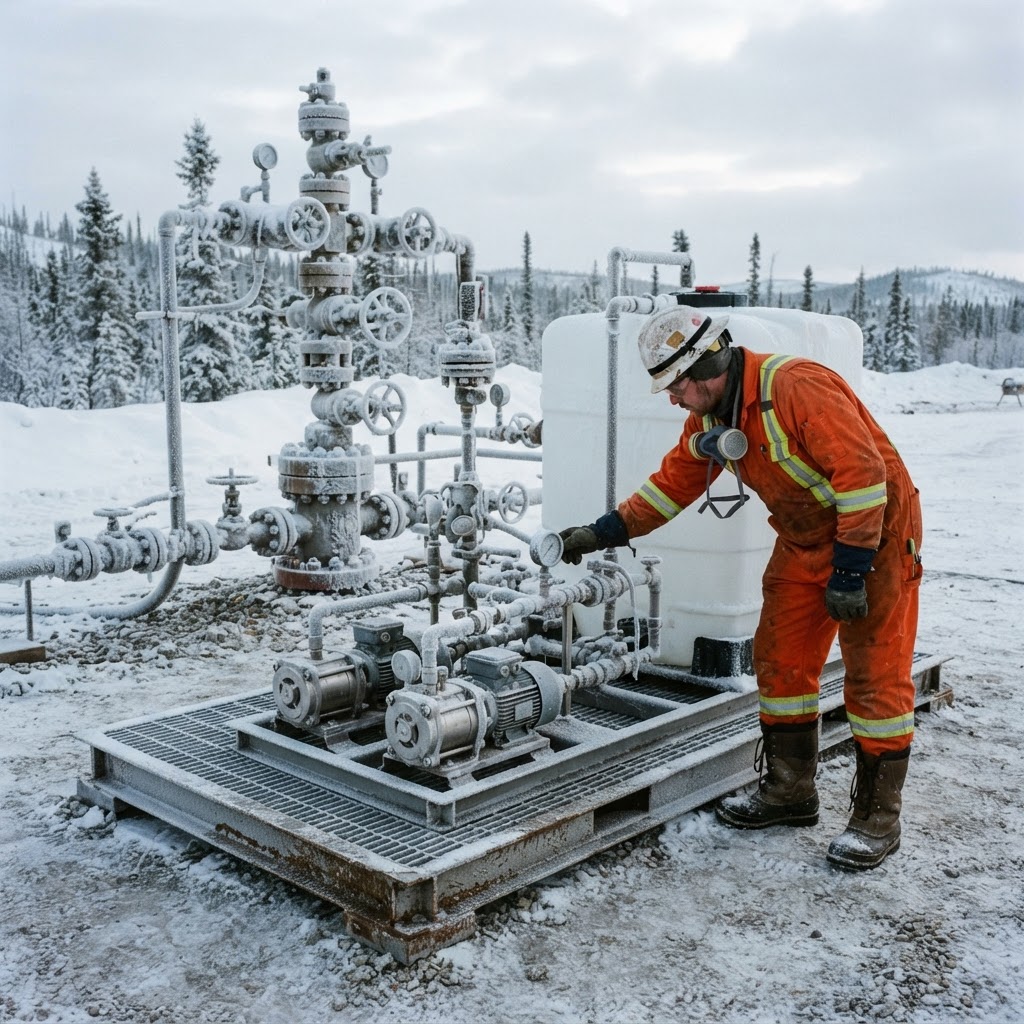
Hydrates: why they form and how to keep them out of your lines
Gas, water, high pressure and low temperature are all it takes to form a solid plug. Hydrate control is about removing one ingredient, or shifting the conditions far enough that it does not matter.
The situation
Gas hydrates are ice-like solids that form when water and light hydrocarbons meet at high pressure and low temperature. They can block pipelines, valves and instruments. Control relies on dehydration, heating, insulation, pressure management and inhibitors such as MEG or methanol.
What hydrates are
Gas hydrates are ice-like solids that form when water and light gases meet at high pressure and low temperature. They can block pipelines, valves and instruments in minutes, and plugs can trap pressure that is dangerous to release.

The hydrate curve
For any gas there is a curve of pressure against temperature. On the cold, high-pressure side of the curve, hydrates can form. Design and operations aim to keep the system on the safe side with margin, or to make hydrates unable to form even when it crosses.
Control options
- Remove the water through dehydration. The most reliable route where it can be done.
- Keep the fluid warm with insulation or heating. Works in steady flow, but shutdowns and restarts need special care.
- Thermodynamic inhibitors such as MEG or methanol shift the hydrate curve. They need large volumes; MEG is often regenerated and reused.
- Low-dose hydrate inhibitors delay formation or keep crystals small and mobile. Useful for moderate subcooling, but must be tested on actual fluids.
The risky moments
Most hydrate events happen during transients: start-up, shutdown, depressurisation or blowdown. Expansion across valves causes sharp cooling. Operating procedures should cover inhibitor injection before restart and safe ways to depressurise.
If a plug forms
Treat a plug as a pressure hazard. Depressurise from both sides where possible, never from one side only, and follow a written remediation procedure.
Key Takeaways
- Hydrates need water, light gas, pressure and low temperature.
- Transients such as restart and blowdown carry most of the risk.
- Choose control by how much subcooling you need to cover.
- Treat a hydrate plug as a trapped-pressure hazard.
How Atticus helps
We assess hydrate risk across operating envelopes, select inhibition strategies, size injection systems and write start-up and blowdown procedures that keep systems out of the hydrate region.
Real-world examples
hydrate plug and pressure differential
A flowline plug formed during a cold restart. Depressurising one side only created a large pressure differential across the plug, which can drive it down the line like a projectile. This is a well-known hazard in industry hydrate-remediation guidance.
Valero McKee propane fire — CSB (2007)
At a refinery, water collected in an unused piping dead-leg froze and cracked the pipe. The release of high-pressure propane led to a major fire. Freezing and solids in dead-legs are a related cold-weather hazard.
Read the investigation / sourceIf you get it wrong
- Blocked lines and lost production, sometimes for weeks.
- Projectile hazards and pipe rupture during plug remediation.
- Instrument and valve failures that disable safeguards.
- High inhibitor costs if the strategy is not optimised.
Relevant standards
Links go to the publisher's official page (ISO, IEC, BSI, API, NFPA, HSE and others). Most standards must be bought from the publisher.
- ISO 13623:2017 (BS EN ISO 13623) — Pipeline transportation systemsiso.org
- ISO 20815:2026 — Production assurance and reliability managementiso.org
- API standards catalogue (API 520/521, 580/581, 618, 625, 650, 754 and more)api.org
Further reading
- Clathrate hydratesen.wikipedia.org
- Ethylene glycol (MEG) propertiesen.wikipedia.org
- Piggingen.wikipedia.org
Take this briefing with you
A one-to-two page PDF summary: situation, diagram, key takeaways, consequences, examples and standards.