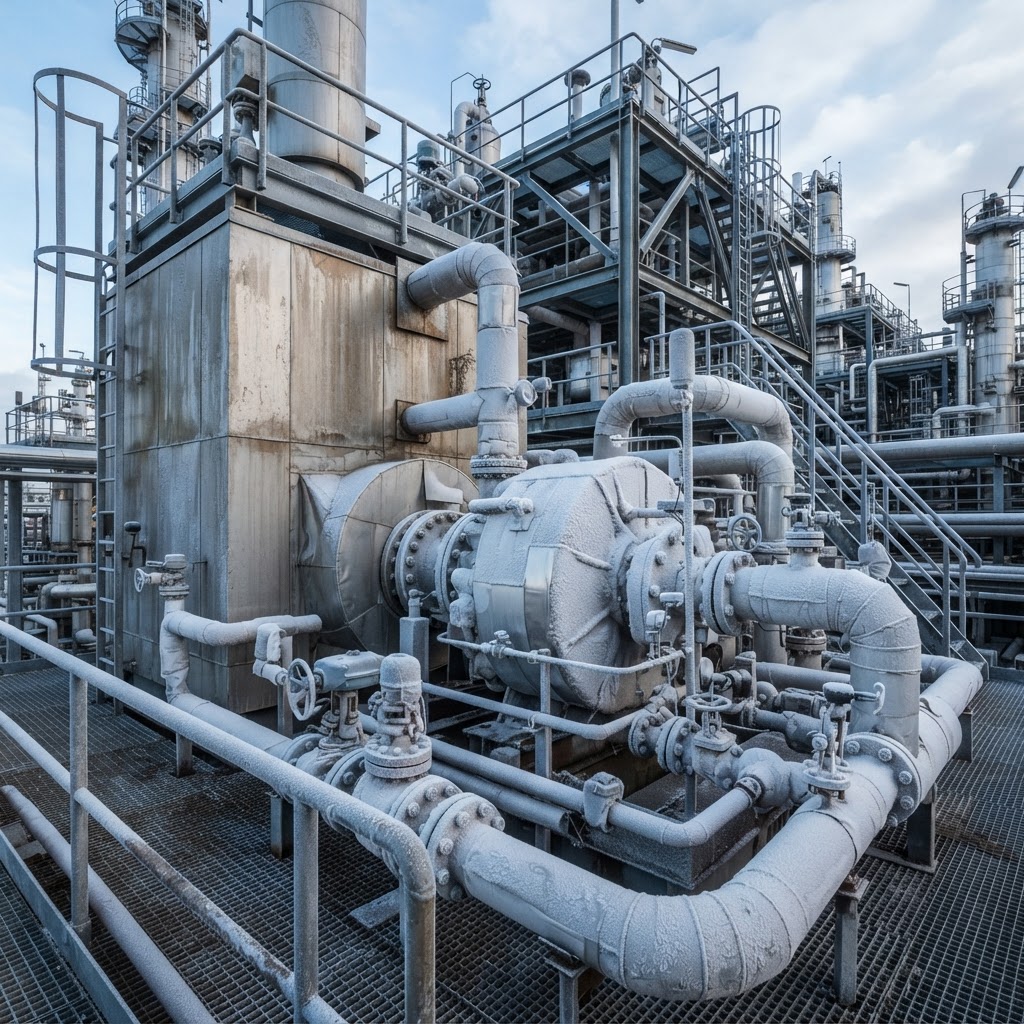
NGL recovery: choosing between refrigeration, lean oil and turboexpander
How much ethane and propane you recover depends on how cold you can make the gas. The technology choice follows from the recovery target, the feed and how much complexity the site can support.
The situation
NGL recovery separates ethane, propane and heavier components from natural gas. Typical options are Joule-Thomson valves, mechanical refrigeration, lean oil absorption and turbo-expanders. The choice depends on gas richness, the recovery target, available pressure drop and the product value.
Start with the recovery target
The first question is what you want to keep out of the sales gas. If the goal is to meet a hydrocarbon dew point and recover most of the propane and heavier, a refrigeration process may be enough. If ethane is valuable, for example as petrochemical feed, a turboexpander process is usually needed.

The main options
Mechanical refrigeration. Gas is chilled with a propane refrigeration loop and liquids are separated, then stabilised. Simple, widely used and tolerant of feed changes. Recovery of ethane is limited.
Lean oil absorption. Heavier oil absorbs the lighter liquids. Common in older plants, now less often selected for new builds because of energy use and equipment count.
Turboexpander. Gas expands through a turbine, cooling sharply and driving a compressor. Very low temperatures allow high ethane recovery. The feed must be dried to very low water content and CO₂ freezing must be checked.
Questions that decide the choice
- How rich is the feed, and how much will it vary over field life?
- Is there a market for ethane, or only for propane and heavier?
- What pressure is available, and is recompression acceptable?
- Is the plant new, or an upgrade that must fit an existing site and utilities?
Downstream of recovery
The liquid product still needs fractionation into ethane, propane, butane and condensate, plus treating, storage and export. These often cost as much as the recovery unit itself and should be part of the concept from the start.
Key Takeaways
- The recovery target drives the technology, not the other way round.
- Turboexpanders deliver high ethane recovery but need deep dehydration.
- Plan fractionation, treating and export together with recovery.
- Design for feed variation over field life, not one composition.
How Atticus helps
We screen NGL recovery concepts, build heat and material balances, and support technology selection and vendor evaluation for new and upgraded gas plants.
Real-world examples
Esso Longford gas plant, Australia (1998)
The Longford gas plant used a lean-oil absorption process. Loss of lean oil flow led to very low temperatures in heat exchangers and then brittle fracture. It shows that the process technology chosen sets specific upset modes that must be designed and trained for.
Read the investigation / sourceexpander chosen for the wrong feed
A turbo-expander plant designed for rich gas received leaner gas than forecast within a few years. Recovery economics fell and the expander ran away from its best-efficiency point. A lower-cost refrigeration scheme would have met the revised business case.
If you get it wrong
- Stranded capital if recovery economics change.
- Low-temperature embrittlement risk if minimum design temperatures are wrong.
- Hydrate or CO2 freezing problems in cold sections.
- Missed product revenue from under-recovery.
Relevant standards
Links go to the publisher's official page (ISO, IEC, BSI, API, NFPA, HSE and others). Most standards must be bought from the publisher.
- ISO 15663:2021 (EN ISO 15663) — Life cycle costingiso.org
- ISO 20815:2026 — Production assurance and reliability managementiso.org
- API standards catalogue (API 520/521, 580/581, 618, 625, 650, 754 and more)api.org
Further reading
Take this briefing with you
A one-to-two page PDF summary: situation, diagram, key takeaways, consequences, examples and standards.