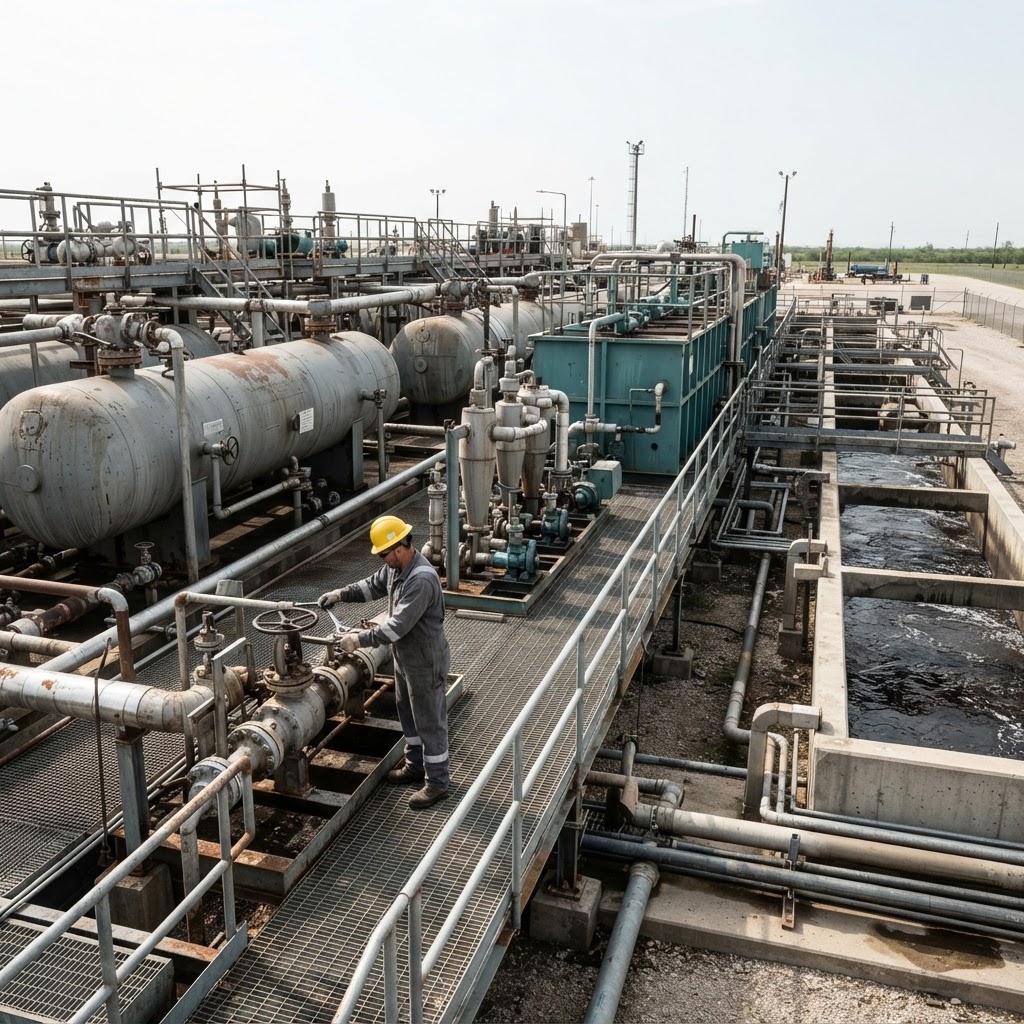
Produced water treatment: building the train step by step
Each stage of a produced water train removes a finer fraction of oil and solids. The disposal route, discharge, injection or reuse, sets how far the train needs to go.
The situation
Produced water must be treated to meet discharge or re-injection limits for oil-in-water, solids and chemicals. A typical train uses separators, hydrocyclones, gas flotation and, where needed, filtration or polishing.
Where the water goes decides the design
Produced water may be discharged, reinjected for pressure support, disposed of in wells, or reused. Each destination has its own limits on oil content, solids, oxygen and chemistry. Start from the destination and work backwards.

Typical stages
- Primary separation in the production separators removes bulk oil.
- Hydrocyclones or skim tanks remove larger droplets.
- Flotation uses gas bubbles to lift finer oil droplets to the surface.
- Filtration removes solids and remaining oil, especially for injection where reservoir plugging is a concern.
- Polishing steps such as membranes or adsorption are added for reuse or strict discharge limits.
Things that upset the train
- Production chemicals that stabilise emulsions.
- Solids from wells or corrosion.
- Sudden changes in water rate after well work.
- Temperature changes that affect separation.
Designing for change
Water rates usually rise over field life. Allow space and tie-ins for extra stages, and check that chemicals used upstream do not defeat the treatment downstream.
Measuring performance
Oil-in-water analysers are only as good as their calibration and sample points. Regular laboratory checks and stage-by-stage sampling show where the train is losing performance.
Key Takeaways
- Design backwards from the disposal or reuse specification.
- Each stage targets a finer fraction; do not skip steps.
- Production chemicals can undermine water treatment.
- Allow for rising water rates over field life.
How Atticus helps
We design and troubleshoot produced water systems and have built browser-based screening tools for treatment trains. We can help size stages and assess upgrade options.
Real-world examples
emulsion upset
A change in demulsifier and rising water cut created stable emulsions. Oil-in-water at the overboard discharge exceeded the permit, leading to a regulatory report and reduced oil rates until chemicals were re-optimised.
injectivity loss
Solids and oil carried over into water-injection wells plugged the formation. Injectivity fell, reservoir pressure support dropped and well workovers were needed.
If you get it wrong
- Permit breaches and environmental fines.
- Production curtailment when water handling becomes the bottleneck.
- Plugged injection wells and lost reservoir support.
- Scale, souring and corrosion in water systems.
Relevant standards
Links go to the publisher's official page (ISO, IEC, BSI, API, NFPA, HSE and others). Most standards must be bought from the publisher.
- US EPA — Oil and gas extraction effluent guidelinesepa.gov
- ISO 20815:2026 — Production assurance and reliability managementiso.org
- ISO 14224:2016 (BS EN ISO 14224) — Reliability and maintenance dataiso.org
Further reading
Take this briefing with you
A one-to-two page PDF summary: situation, diagram, key takeaways, consequences, examples and standards.