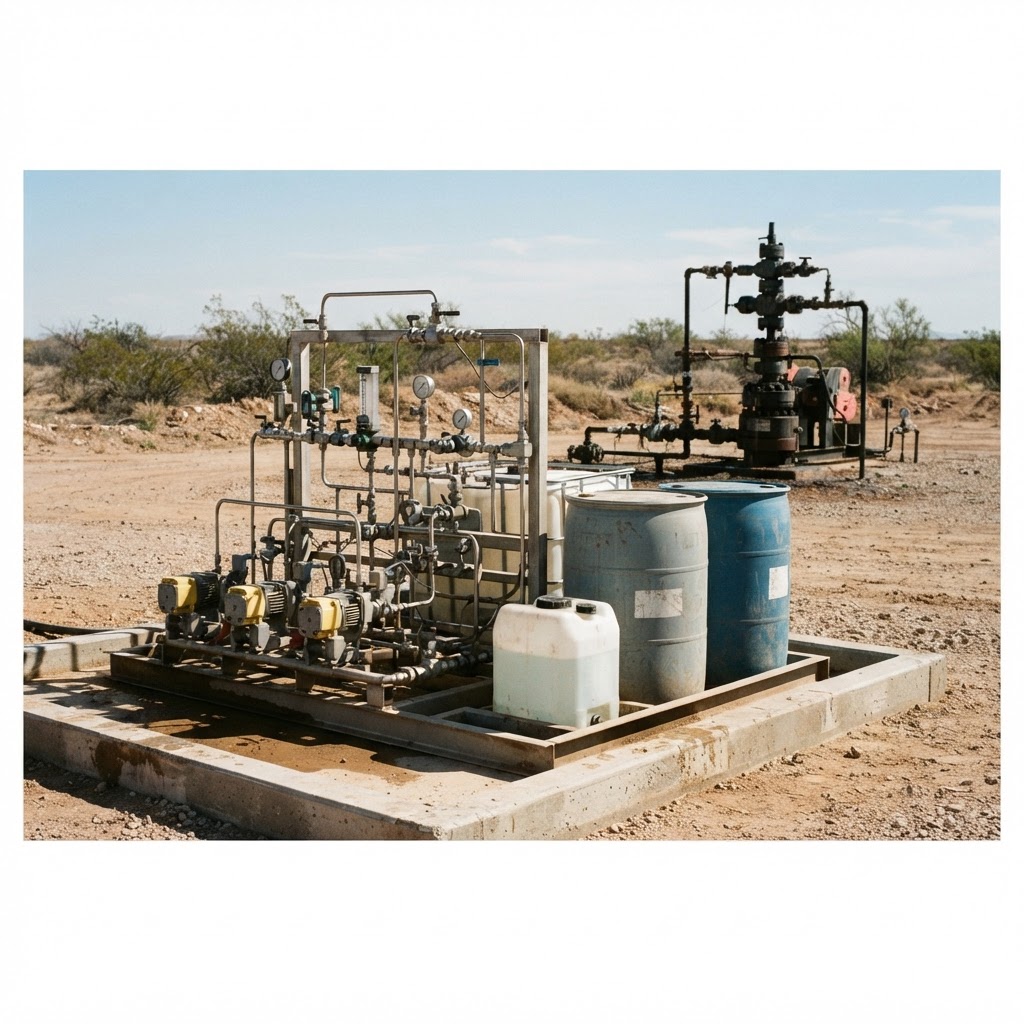
Production chemicals management: getting value from every litre
Corrosion inhibitors, scale inhibitors, demulsifiers and biocides protect assets and keep production flowing. Without active management they waste money or quietly stop working.
The situation
Production chemicals (corrosion and scale inhibitors, demulsifiers, biocides, hydrate inhibitors, H2S scavengers) protect integrity and flow assurance. They must be selected, qualified, dosed, monitored and checked for compatibility.
What chemicals do
Production chemicals manage corrosion, scale, hydrates, emulsions, foam, wax and bacteria. They are often the cheapest barrier against costly failures.

Common problems
- Doses set years ago and never reviewed.
- Injection points blocked or pumps not delivering.
- Chemicals that interfere with each other or with water treatment.
- No measurement of whether the chemical is working.
A managed programme
- Define each threat and the target result.
- Select products through laboratory and field trials.
- Inject at the right location and rate, with reliable pumps.
- Monitor residuals, corrosion rates, scale and water quality.
- Optimise dose and product as conditions change.
- Check compatibility across all chemicals and with downstream processes.
Contracts
Performance-based chemical contracts can align supplier incentives with results, but need clear measures and independent monitoring.
Safety and environment
Storage, handling and discharge of chemicals must meet safety data sheet and permit requirements.
Key Takeaways
- Define the target result for each chemical.
- Measure whether it works, not just how much is used.
- Check compatibility across the whole system.
- Review doses as production conditions change.
How Atticus helps
We audit chemical programmes, review injection systems and help set up performance-based monitoring with suppliers.
Real-world examples
incompatible chemicals
A new scale inhibitor reacted with the corrosion inhibitor in a shared injection line, forming gunk that blocked the quill. Corrosion protection was lost for weeks before anyone noticed.
Prudhoe Bay pipeline leak (2006)
The Prudhoe Bay transit line leak showed the consequences of inadequate corrosion control and monitoring, including a lack of cleaning pigs and sediment management.
Read the investigation / sourceIf you get it wrong
- Corrosion and loss of containment.
- Emulsions, scale and blockages.
- Environmental discharges and permit breaches.
- High chemical spend with little benefit.
Relevant standards
Links go to the publisher's official page (ISO, IEC, BSI, API, NFPA, HSE and others). Most standards must be bought from the publisher.
- AMPP (formerly NACE) standardsampp.org
- ISO 15156-1:2020 (NACE MR0175) — Materials for H2S-containing environmentsiso.org
- US EPA — Oil and gas extraction effluent guidelinesepa.gov
Further reading
Take this briefing with you
A one-to-two page PDF summary: situation, diagram, key takeaways, consequences, examples and standards.