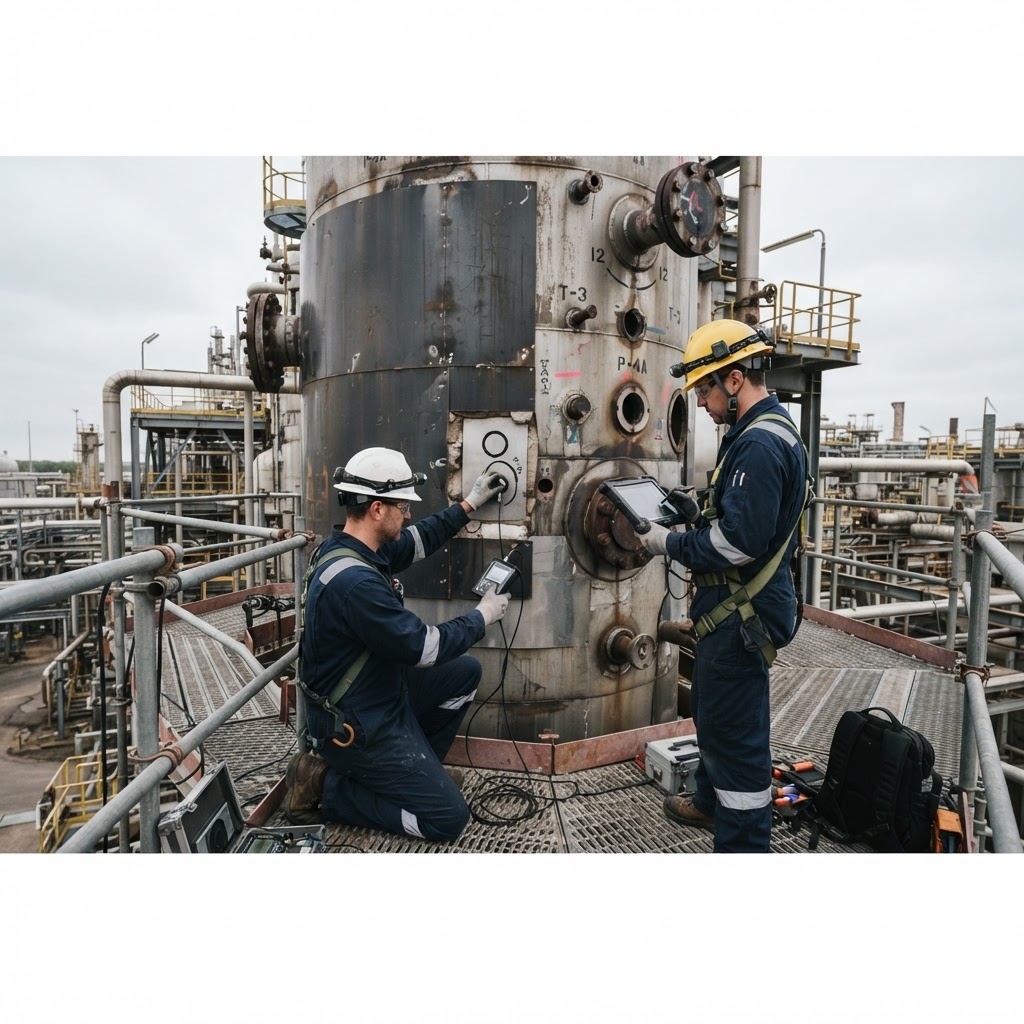
Risk-based inspection: spending inspection effort where it matters
Fixed inspection intervals treat every vessel the same. Risk-based inspection ranks equipment by likelihood and consequence of failure and sets intervals to match.
The situation
Risk-based inspection (RBI) ranks equipment by probability and consequence of failure. It then focuses inspection effort where risk is highest, setting intervals and methods instead of applying fixed calendar periods.
The idea
Risk-based inspection (RBI) ranks equipment by the likelihood of failure and the consequence if it fails. High-risk items get more frequent or more searching inspection; low-risk items can be inspected less often without increasing overall risk.

Likelihood
Driven by damage mechanisms, corrosion rates, remaining wall, operating history and the effectiveness of past inspections.
Consequence
Driven by the fluid, inventory, pressure, location, and the potential for fire, toxic release, environmental harm and lost production.
What RBI produces
- A risk ranking for each item or corrosion circuit.
- An inspection plan: what technique, where, and when.
- A record of the assumptions so the plan can be updated.
Getting it right
- Data quality matters. Poor records push items into higher risk until better data exists.
- Damage mechanisms must be identified properly, or the wrong inspection technique will be chosen.
- RBI plans must be updated after process changes, upsets and inspection findings.
Benefits
Done well, RBI improves safety and reduces cost at the same time, by focusing effort and extending intervals with justification.
Key Takeaways
- Rank by likelihood and consequence, then set intervals.
- Match the technique to the damage mechanism.
- Poor data raises risk until it is improved.
- Update the plan after changes and findings.
How Atticus helps
We set up and review RBI programmes, identify damage mechanisms, and help operators justify interval extensions with sound data.
Real-world examples
Chevron Richmond refinery fire — CSB (2012)
At Chevron Richmond, sulfidation corrosion thinned susceptible piping that had not been targeted with comprehensive inspection. The CSB emphasised identifying active damage mechanisms and inspecting the susceptible components, which is the core logic of RBI.
Read the investigation / sourceRBI with poor data
An RBI study used design corrosion rates instead of measured data. It extended intervals on lines that were actually thinning quickly. RBI is only as good as its damage-mechanism review and inspection data.
If you get it wrong
- Failures in equipment wrongly ranked as low risk.
- Wasted inspection effort on low-risk items.
- Regulatory challenge if the methodology is not defensible.
- Unplanned outages.
Relevant standards
Links go to the publisher's official page (ISO, IEC, BSI, API, NFPA, HSE and others). Most standards must be bought from the publisher.
- API standards catalogue (API 520/521, 580/581, 618, 625, 650, 754 and more)api.org
- DNV-RP-G101 — Risk-based inspection of topsides static mechanical equipmentdnv.com
- ISO 55000:2024 — Asset management: vocabulary, overview and principlesiso.org
- HSE L122 — Safety of pressure systems (PSSR ACoP)hse.gov.uk
Further reading
Take this briefing with you
A one-to-two page PDF summary: situation, diagram, key takeaways, consequences, examples and standards.