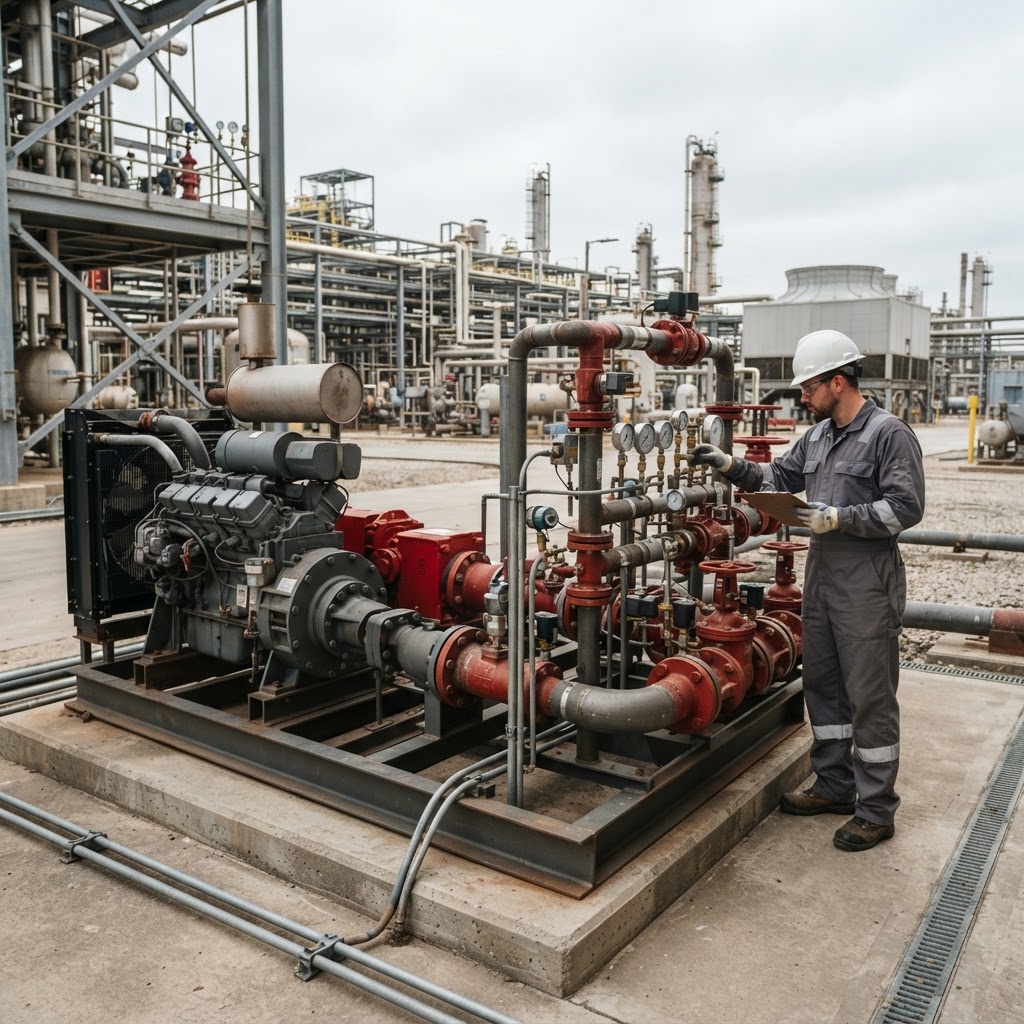
Safety-critical elements and performance standards
A safety-critical element is any equipment whose failure could cause or fail to prevent a major accident. Each needs a performance standard that says what good looks like and how it is tested.
The situation
Safety-critical elements (SCEs) are the equipment and systems whose failure could cause or fail to limit a major accident. Each SCE needs a performance standard (functionality, availability, reliability, survivability) and an assurance and verification scheme.
What makes equipment safety-critical
If its failure could cause a major accident, or its failure means a major accident is not prevented or limited, it is safety-critical. Typical examples: pressure containment, relief systems, emergency shutdown, fire and gas detection, fire protection, and emergency power.

Performance standards
Each safety-critical element (SCE) needs a performance standard covering:
- Functionality: what it must do, such as close within a set time.
- Availability and reliability: how often it must work when needed.
- Survivability: whether it must keep working during a fire or explosion.
- Dependencies: what it needs, such as power or instrument air.
Assurance and verification
Maintenance and inspection tasks show that each element still meets its standard. Independent verification checks that the standards are right and that the tasks are done.
Common gaps
- SCEs not flagged in the maintenance system.
- Overdue tests that are not escalated.
- Standards that describe the equipment but not the required performance.
- Impairments managed informally rather than through a risk assessment.
Making it visible
Simple dashboards of SCE test compliance and open impairments help operations see barrier health at a glance.
Key Takeaways
- Link every SCE back to a major accident hazard.
- Write standards around performance, not equipment description.
- Flag SCEs in the maintenance system and escalate overdue tests.
- Manage impairments with formal risk assessment.
How Atticus helps
We identify SCEs, write performance standards, and review assurance and verification schemes for new and existing facilities.
Real-world examples
Buncefield oil storage depot — HSE (2005)
At Buncefield the independent high-level switch, a safety-critical element, was inoperable without anyone knowing. A performance standard with periodic proof testing would have revealed the failure.
Read the investigation / sourcePiper Alpha — HSE public inquiry (1988)
The Cullen inquiry into Piper Alpha drove the UK's goal-setting offshore safety case regime. Verification of safety-critical elements is a central part of that regime.
Read the investigation / sourceIf you get it wrong
- Undetected SCE failures that remove barriers.
- Regulatory enforcement where the verification scheme is weak.
- Major accident escalation.
- Loss of licence to operate.
Relevant standards
Links go to the publisher's official page (ISO, IEC, BSI, API, NFPA, HSE and others). Most standards must be bought from the publisher.
- HSE L111 — Guide to the COMAH Regulations 2015hse.gov.uk
- IEC 61511-1 (BS EN 61511) — Functional safety: SIS for the process industrywebstore.iec.ch
- ISO 13702:2024 (EN ISO 13702) — Control and mitigation of fires and explosionsiso.org
- ISO 17776:2016 — Major accident hazard management during designiso.org
Further reading
Take this briefing with you
A one-to-two page PDF summary: situation, diagram, key takeaways, consequences, examples and standards.